Northern Ireland graduated licensing: what it changes
Northern Ireland's graduated driver licensing began on 1 October 2026. It does not apply in England, Scotland or Wales — here is what changes for NI learners.
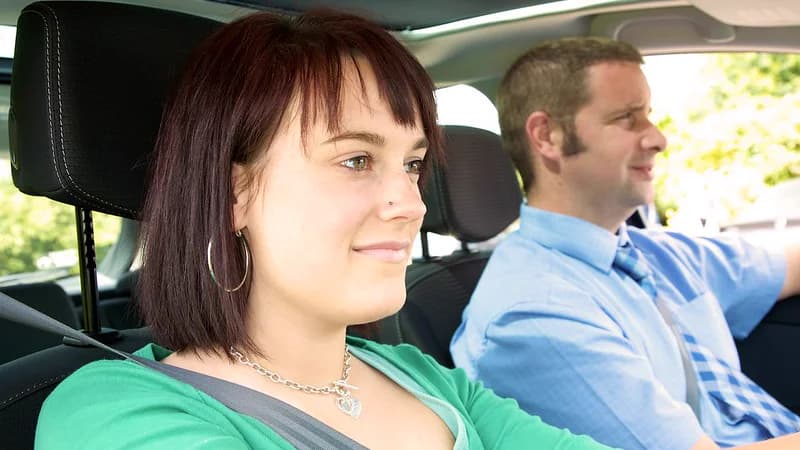
Northern Ireland has a new system for learning to drive and for the first two years after passing: graduated driver licensing, in force since 1 October 2026. It applies only in Northern Ireland. Learners in England, Scotland and Wales are not under this system, and none of its rules — the six-month minimum learning period, the logbook, the two-year R-plate period — apply to them.
The rule
Graduated driver licensing is a phased approach: structured learning before the test, a revised test from April 2027, and post-test protections that last two years. The Department for Infrastructure describes it as the most significant reform to driver licensing and testing in Northern Ireland in almost 70 years. Its stated aim is to reduce the disproportionate involvement of new and young drivers in fatal and serious collisions: in 2024, 164 people were killed or seriously injured in collisions where a car driver aged 17–23 was responsible, an age group that accounts for 24% of fatal or serious collisions while holding just 8% of licences.
Every detail, in order
Who it applies to. Anyone whose provisional licence entitlement for cars (category B) or motorcycles begins on or after 1 October 2026, whatever their age. Learner motorcyclists are included, with some differences noted below.
Minimum learning period (cars only). A car learner cannot sit the practical test until at least six months after the date their provisional licence becomes valid. This does not apply to motorcyclists, who must complete compulsory basic training before the training introduced by graduated licensing. One exemption from the six-month period is published: learners who can evidence entitlement to Carer's Allowance. Even with that exemption, the learner must still complete the programme of training and logbook before sitting the test.
Programme of training and logbook. Before booking a practical test, the learner must complete a programme of training detailing the learning required to become a safe driver, and record it in a logbook. The programme and logbook are delivered through a mobile app and a web browser option, and completion feeds into the DVA booking system so a test can be booked once every element is complete: the six-month period, the theory test, the programme and logbook, and compulsory basic training for learner riders where required. The learner is responsible for completing the programme; it is signed off by an approved instructor or supervising driver. The app for the category A and category B programme and logbook costs £17 to the learner. The Department states the cost of applying for a practical test itself does not change.
The revised test, from 1 April 2027. A new practical driving test will be introduced on 1 April 2027, six months after the scheme began, to accommodate the minimum learning period. It extends the independent driving section to approximately 20 minutes, introduces sat nav use, and asks show me, tell me questions on the move. The overall standard for passing remains unchanged.
After passing: two years of R plates. A newly qualified driver must display a distinguishing R plate for two years after receiving a full licence, up from 12 months. The two years are split: a blue R on a white background for the first six months, then a white R on a blue background for the remaining 18 months. Under the new system, newly qualified drivers may drive up to posted speed limits — the old 45mph restriction for new drivers does not apply to drivers entering this system.
Night-time passenger restriction (first six months, under-24s only). For the first six months after passing, a new driver aged under 24 may carry no more than one passenger aged between 14 and 20 between 23:00 and 06:00. Exemptions apply for immediate family members, and the restriction does not apply if a person aged 21 or over who has held a full licence for three years is in the front seat. This restriction does not apply to motorcyclists, though newly qualified riders must still display the two-part R plate for two years.
Penalties. Breach of the new conditions carries specific offences: failure to display the required R plate during the two-year period, and driving with an unauthorised passenger during the first six months, each carry a potential £1,000 fine alongside three penalty points. Separately, the two-year probationary period under the Road Traffic (New Drivers) (Northern Ireland) Order 1998 continues: six or more penalty points within two years of passing means the licence is revoked and re-testing is required.
Before vs now, side by side
| Before graduated licensing | Under graduated licensing | |
|---|---|---|
| Minimum learning period (cars) | None | At least 6 months from provisional entitlement |
| Training record | None | Programme of training + logbook, signed off before booking |
| Restricted period after passing | 12 months, amber R plates, 45mph limit | 24 months, new two-part blue/white R plates, posted speed limits |
| Night-time passengers (under-24s, first 6 months) | No limit | At most one passenger aged 14–20 between 23:00 and 06:00, with exemptions |
| Practical test | Current format | Revised format from 1 April 2027 (longer independent driving, sat nav, on-the-move questions) |
Who is on the old rules, and until when
The transition matters, because for months two systems run side by side:
- If your provisional entitlement began before 1 October 2026, you continue as now and can take the current practical test up to and including 31 March 2027. If you pass in that window, you stay on the old restrictions: amber R plates and the 45mph limit for 12 months.
- If your provisional entitlement began on or after 1 October 2026, you are under graduated licensing.
- From 1 April 2027, all learners must have completed the programme of training and logbook before booking a practical test, and the new test applies.
- One transitional exception is published: a learner whose entitlement began after 1 October 2026 but who is exempt from the minimum learning period, and who passes before 31 March 2027, takes the current test but then follows the new system — posted speeds and the new two-part R plates.
Common misunderstandings
- "New October rules" headlines do not mean GB rules changed. This scheme is made under Northern Ireland law and administered by Northern Ireland's Department for Infrastructure and DVA. It has no effect on learners in England, Scotland or Wales, whose booking rules are the DVSA rules already covered in this News section.
- Passing before the transition ends does not put you on the new plates. Which R plate you display depends on when your provisional entitlement began and when you pass, as set out in the table above — not on which system sounds newer.
- The six-month wait is not the whole scheme. A learner who simply waits six months but has not completed the programme and logbook cannot book the test under the new system; completion is what unlocks booking.
- The 45mph limit has not been abolished for everyone. It no longer applies to drivers entering the new system, but drivers on the old restrictions keep it until their 12-month restricted period ends.
What to do now
- If you are learning in Northern Ireland, work out which side of 1 October 2026 your provisional entitlement falls on — that date, not the date you started lessons, decides which system applies to you.
- If you are under graduated licensing, complete the programme of training and logbook in full and have it signed off; do not assume a test can be booked on the six-month date alone.
- If you passed before 1 October 2026 or pass during the transition under the old rules, keep displaying the amber R plates and observing the 45mph limit until your restricted period ends.
- If you are learning in England, Scotland or Wales, ignore graduated licensing headlines for your own booking: your rules have not changed because of this scheme. Check the official guidance for your own jurisdiction before acting on any headline.
Sources
- Northern Ireland Department for Infrastructure, "Graduated Driver Licensing – FAQs", https://www.infrastructure-ni.gov.uk/articles/graduated-driver-licensing-faqs — checked 1 November 2026. Every rule, date, figure and penalty in this post comes from this official page.
- Auto Express, "Graduated driving licence scheme launched in the UK: England, Scotland and Wales to follow NI?", 1 October 2026, https://www.autoexpress.co.uk/news/370561/graduated-driving-licence-scheme-launched-uk-england-scotland-and-wales-follow-ni — Tier 2 second source for the launch date and GB contrast only; no rule claim in this post rests on it alone.
Learning to drive in Manchester?
Free mock theory tests and hazard perception practice, and lessons with instructors who can see how you're doing.