Forward Bay Parking on the Driving Test: How It Works
Last updated 1 November 2026
Forward bay parking on the UK driving test: how to drive in, finish inside the lines, and reverse out safely.
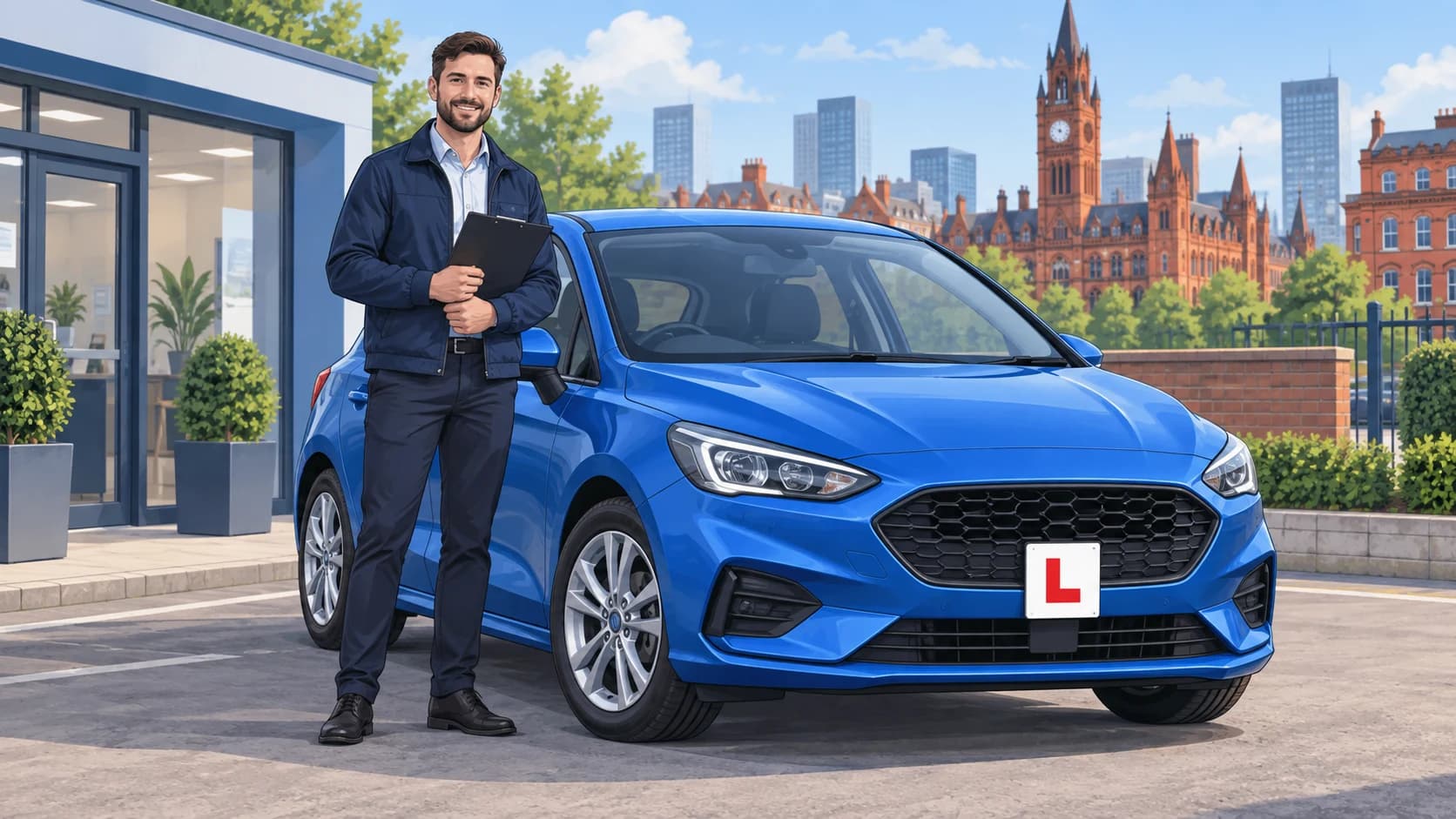
Forward bay parking is the simplest bay manoeuvre to describe, and the easiest to get wrong by rushing. You drive forward into a marked bay, finish inside the lines, and then reverse out safely. The examiner is not looking for a perfect first attempt at speed — they are looking for control, position and, above all, observation.
You will be asked for only one reversing manoeuvre on your test. Forward bay parking is one of the options, alongside reverse bay parking, parallel parking, and pulling up on the right.
What happens on the test
The examiner will usually ask for this manoeuvre at a test centre car park, at the start or end of your test. They will tell you which bay area to use, or ask you to choose a suitable bay. Drive in forwards, stop inside the bay, and then, when asked, reverse back out into the lane or car park roadway.
Do not assume you will be asked to reverse out immediately, and do not assume you will not. Wait for the instruction.
Driving in
Approach slowly and choose a bay you can enter cleanly, with space on both sides if possible. Position the car so you can steer in a smooth arc into the bay, rather than turning sharply at the last moment.
As you enter, keep checking for pedestrians, other cars reversing, and cars driving through the car park. Car parks are shared spaces, and people on foot can appear from between parked cars with very little warning.
Finish with the car reasonably straight, inside the lines, and not sticking out into the lane. You do not need to be perfectly centred, but you do need to be fully inside the bay and not over a line into the next bay. If you are badly out of position, it is better to correct it carefully, with observation, than to leave the car across a line.
Reversing out
This is where most forward bay faults happen, because learners relax once they are parked. Before you move, check all around: mirrors, over both shoulders, and for pedestrians behind you. Reverse slowly in a straight line first, then steer as needed to join the lane, keeping your observations going throughout.
If another car or a pedestrian comes into your path, stop and wait. A pause is not a fault. Reversing into someone's path because you were in a hurry to finish is.
Common mistakes
- Entering too fast and finishing crooked or over a line.
- Only checking forwards while driving in, and missing a pedestrian to the side.
- Reversing out without an all-round check.
- Steering too early on the way out and swinging into the next bay or lane.
- Trying to fix a bad position with a rushed shunt, without looking.
How your instructor will teach it
Your instructor will show you a routine for the car you are learning in — where to start your turn, what to look at, and how to judge when you are straight. Reference points are a learning aid, not a rule: they change with the car, the bay size and the angle of approach, so practise the observation routine as much as the steering.
Practise in different car parks, not just one familiar one, so you are not thrown by a different bay layout on test day. And read our general parking manoeuvres guide and our faults guide alongside this one, so you know how a bay fault is marked.
If you are learning with Learn and Drive, bay parking is covered as part of test preparation. See our areas we cover page for pickup coverage — we operate door-to-door, not from local branches.
Your instructor will adapt the exact method to your car. If their routine differs slightly from this guide, follow theirs on test day.
Related guides
Learning to drive in Manchester?
Free mock theory tests and hazard perception practice, and lessons with instructors who can see how you're doing.