Driving Crash Course in Manchester: Manual Explained
A manual driving crash course in Manchester explained: what it is, how clutch and gear skills shape it, who it suits, and what it cannot promise.
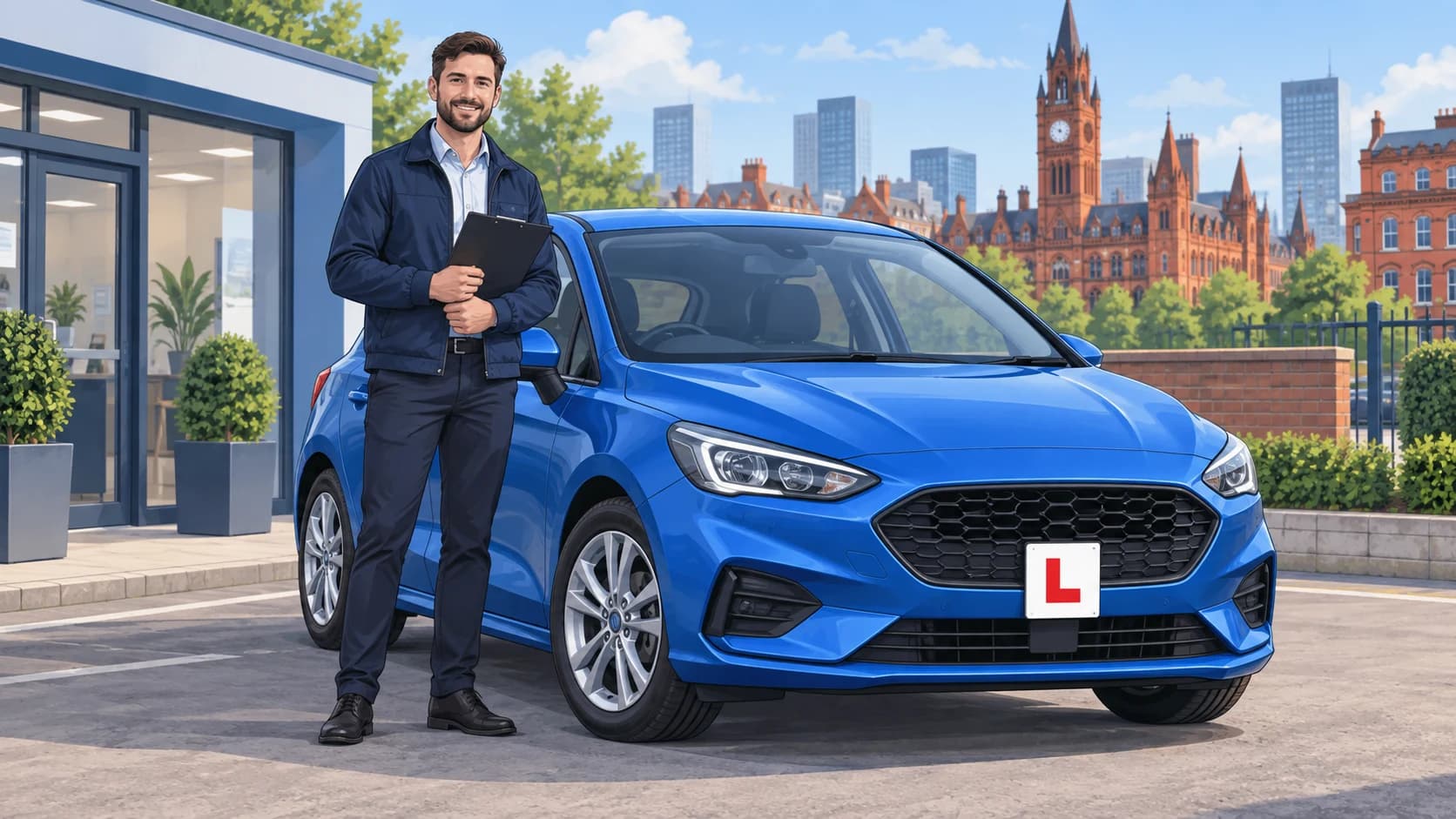
A driving crash course is an intensive course by another name, but the word crash carries a warning inside it: this is fast, concentrated learning, and it only works when it is built properly. This guide explains what a crash course means when you are learning manual in Manchester, why the manual gearbox changes the shape of the course, who it suits, and what it honestly cannot do.
What a crash course is — and is not
A crash course is a block of driving lessons delivered over a short, concentrated period, designed to take you from where you are now to test standard in one sustained push. The word does not mean rushed, and it does not mean that any part of learning is skipped. You still learn everything the practical test requires: car control, observation, judgement, manoeuvres and independent driving. The difference from weekly lessons is purely the timetable.
What a crash course is not matters just as much. It is not a way to avoid learning properly, it is not a guaranteed pass, and it is not a guaranteed test date. Your practical test is booked separately through the official GOV.UK service, and you must have passed your theory test before you can book it. Any course that talks as though the test date or the pass comes with the package is promising something outside its control.
Why manual changes the shape
Learning manual adds a layer that automatic learners do not face: clutch control, gear choice, and the coordination of the two with steering and observation. In a weekly routine, clutch control is often the skill that takes longest to feel natural, because it needs repetition across many different situations: pulling away on the flat, hill starts, slow traffic, and manoeuvres where the car must crawl under full control.
In a crash course, that repetition happens in quick succession, which is both the advantage and the challenge. The advantage is that clutch feel builds fast when you practise it many times in a few days; the skill stops being something you think about and starts being something your left foot simply does. The challenge is that clutch work is tiring and frustrating in the early stages, and stalling in traffic on a busy Manchester road can dent confidence quickly. A well-built manual crash course therefore puts clutch foundations first and does not move on to complex traffic until pulling away, stopping and slow control are reliable.
Gear choice follows the same logic. Choosing the right gear for the speed and the road, changing smoothly without losing observation, and recovering calmly from a wrong gear are skills that need many repetitions. A crash course gives you those repetitions in days rather than months, but only if the course is structured to revisit them constantly rather than treating them as a single early lesson.
How a manual crash course usually runs
A manual crash course usually opens with an assessment, so the instructor can see your current clutch control, observation and judgement rather than assuming them. Then comes foundation work: clutch control, smooth pull-aways and stops, and slow-speed control. Traffic skills follow: junctions, roundabouts and busier roads, with gear choice practised in real situations rather than in isolation. Manoeuvres come once slow control is reliable, because every manoeuvre depends on it. Finally, a mock test under test conditions shows what holds up under pressure and what still needs work, and the last sessions fix whatever the mock reveals.
That sequence is not accidental. Each stage depends on the one before it, and a course that rushes the foundations to reach the interesting parts faster usually pays for it later, when faults appear under test pressure.
Who a manual crash course suits
A manual crash course suits learners with some driving experience already: people who have had lessons before, returning learners, and learners switching from automatic who need to build clutch and gear skills onto existing road sense. It also suits learners who can clear their calendar properly and concentrate for full days without exhaustion undermining the learning.
It suits less well anyone who has never driven at all and who knows they need time for new physical skills to settle. Clutch control is a physical skill, and physical skills sometimes need sleep and rest between sessions before they click. If that sounds like you, a semi-intensive spread, with lessons several times a week rather than every day, may be the wiser version of the same idea.
One practical point is worth knowing before you choose manual or automatic. A manual driving licence lets you drive both manual and automatic cars, while passing in an automatic limits you to automatic cars. That flexibility is a genuine reason many learners choose manual even though it takes more initial effort, and it is worth weighing against the steeper early learning curve.
The test question
Finish the course ready, and then book the test when you and your instructor agree you are ready — not before, and not because the course has ended. If the mock test shows you need more lessons, take them. A crash course that ends with an honest verdict is doing its job; a crash course that declares everyone ready regardless is not.
- GOV.UK, "Learn to drive a car: step by step": https://www.gov.uk/learn-to-drive-a-car
- GOV.UK, "Book your driving test": https://www.gov.uk/book-driving-test
Learning to drive in Manchester?
Free mock theory tests and hazard perception practice, and lessons with instructors who can see how you're doing.