Best Car for a Driving Test: How to Choose
What makes the best car for a driving test? Size, visibility, controls and dual controls — and why your instructor's car is usually the right choice.
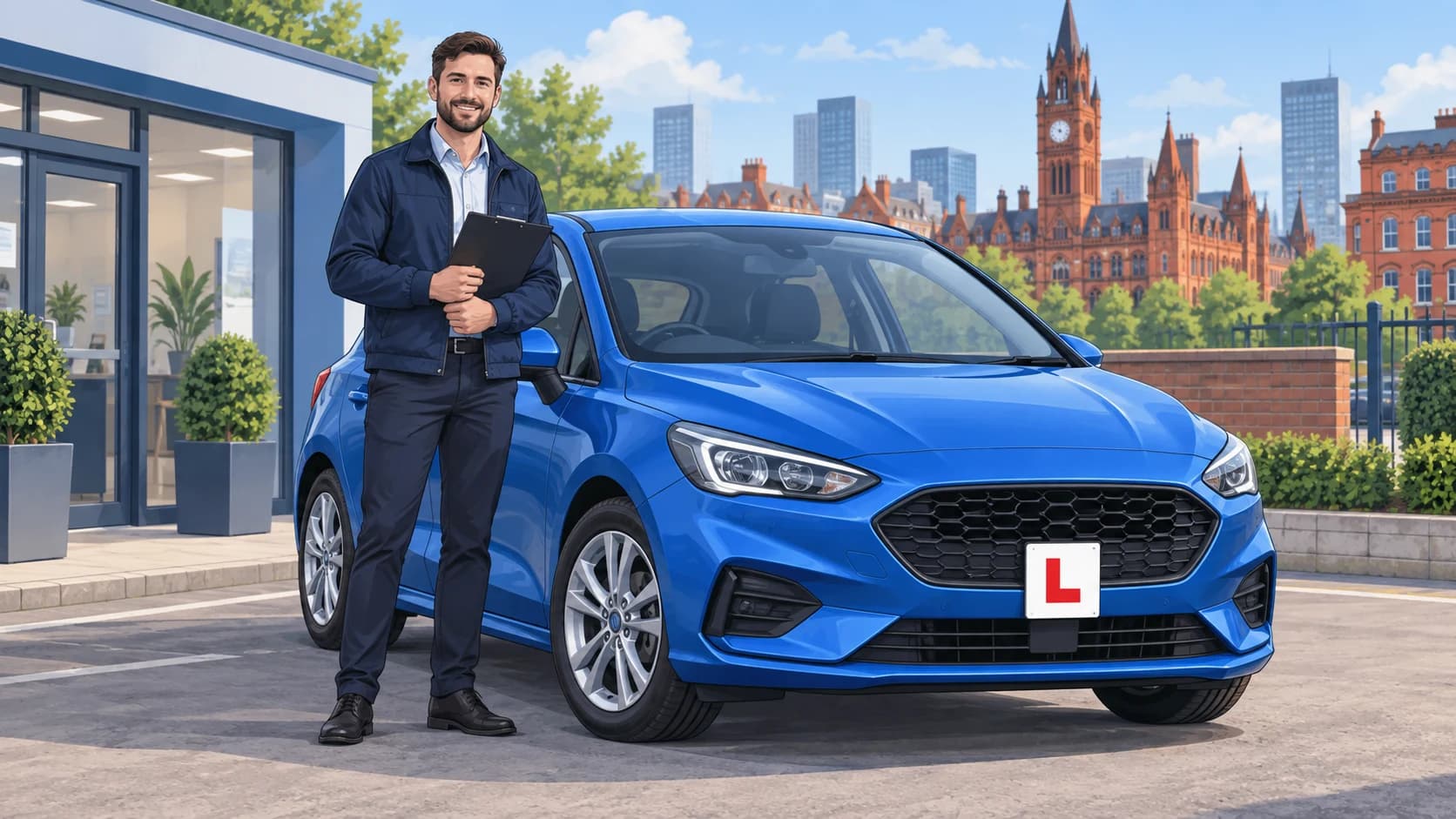
There is no single best car for a driving test — no model that guarantees a pass, and no ranking worth trusting. What matters is whether the car helps you drive well on the day: easy to see out of, easy to control, easy to park, and set up the way the examiner needs it to be. This guide explains what to look for when you are choosing, whether that means your instructor's car or your own.
The short answer: your instructor's car is usually best
For most learners, the best car for the test is the one you have been learning in. Your instructor's car is already checked, insured for the test, fitted with dual controls and an extra interior mirror for the examiner, and familiar to you in every way that matters — the weight of the clutch, the sharpness of the brakes, the size of the blind spots. You have spent dozens of hours in it. On test day, familiarity is worth more than any feature a different car might offer.
That is the default answer, and it is the right one for most people. The rest of this guide is for the learners who are considering their own car — either because they want to be tested in the car they will drive afterwards, or because they have a car available and want to know whether it is a good choice.
Size: small is easier, but not too small
A smaller car is easier to manoeuvre, easier to park, and easier to place accurately on the road — and the test includes a reversing exercise and several tight situations where size matters. A large car is not a disadvantage in itself, but it gives you more to manage at exactly the moments when you are under pressure.
There are limits, though. Whatever car you choose must be able to reach at least 62mph, have four wheels, and have a maximum authorised mass of no more than 3,500 kg. Those are GOV.UK's rules for the test car, and they rule out the very smallest vehicles as well as anything too large. A normal small or medium hatchback sits comfortably inside them; a van does not, and neither do some very small two-seaters.
Visibility: the examiner has to see too
The examiner needs all-round vision from the passenger seat, and that is a hard requirement, not a preference. GOV.UK names cars that cannot be used in the test at all because they do not give the examiner all-round vision — panel vans, several convertibles, and a handful of specific models. If you are thinking of using a coupe or a convertible, check with your test centre first, and if you use a convertible the roof must stay up throughout the test. Our guide to using your own car for your test has the full list and the checklist the examiner applies.
Visibility matters for you as well as the examiner. A car with thin pillars, large windows and clear mirrors makes observation easier, and observation is the single biggest reason learners fail — not making effective observations at junctions is the number one fail reason in the DVSA's published list. A car that hides things from you makes the test harder. When you sit in a car you are considering, check what you can see: over the bonnet, through the rear window, and in all three mirrors without straining.
Controls: light, clear and predictable
The best test car has controls that are light and predictable. A heavy clutch makes smooth move-offs harder, especially on a hill. Steering that is vague or over-assisted makes it harder to place the car precisely. Pedals that are close together make it easy to catch the wrong one under pressure. None of these are rules — they are the difference between a car that helps you and a car that fights you.
If you are choosing between two cars you own or can borrow, drive both for a lesson if you can and notice which one you control more easily. Your instructor can tell you in one drive which car suits you better. The features that help are the simple ones: a clear handbrake you can reach easily, a gear lever with a clean pattern, and mirrors that adjust properly. The driver aids that are allowed in the test — electronic parking brake, hill-start assist, parking sensors and cameras — can help, but they do not replace good control, and some aids are banned during the test, including self-parking and your own sat nav. The full allowed-and-banned list is in our own-car guide.
Dual controls: lessons are safer with them
Your own car does not need dual controls for the test — that rule only applies to hire cars, which must be fitted with them. But dual controls matter for the lessons leading up to the test, not just for the test itself. Your instructor's car has them, which means your instructor can take over instantly if something goes wrong. Your own car does not, which means your instructor is a passenger with no brake.
That does not make your own car a bad choice for the test, but it does make it a worse choice for learning in. If you plan to use your own car on test day, learn in your instructor's car and switch to yours for the last few lessons, so you are familiar with it before the test without giving up the safety net while you are still learning.
Manual or automatic
You can take the test in a manual car, with three pedals, or in an automatic or semi-automatic car, with two pedals. The choice matters after you pass: a pass in a manual car covers both, while a pass in an automatic or semi-automatic restricts you to automatic cars only. For the test itself, an automatic removes clutch control and gear changes from the things you have to manage, which some learners find easier — but it does not remove observation, judgement or road positioning, which are where most tests are actually failed. Choose the gearbox you have learned in, not the one you think is easier on the day.
What to check before you decide
If you are set on using your own car, run through the essentials before you book. The car must be taxed, have a current MOT if it is over three years old, and be insured for a driving test — not just for learning. It must have L plates front and rear, an extra interior rear-view mirror for the examiner, and a passenger seatbelt and head restraint. There must be no warning light showing a safety issue, no tyre damage, and no space-saver spare fitted. The full checklist, with the recall check and the dashcam rules, is in our own-car guide — work through it the week before the test, not the morning of it. If the car fails any item, the test is cancelled and you have to book and pay again: £62 for a weekday test, £75 in the evening, at the weekend or on a bank holiday.
The honest test of a car is not a list but a lesson. Take the car you are considering for a drive with your instructor, including a reversing exercise and a few junctions, and ask them plainly whether it helps you or holds you back. They have seen hundreds of learners in dozens of cars, and they will know in ten minutes what a specification sheet cannot tell you. The best car for your driving test is the one you drive best in — and for most learners, that is the car they have already been learning in.
Sources: GOV.UK, "Driving test: cars" (https://www.gov.uk/driving-test) — checked 22 November 2026. GOV.UK, "Learn to drive a car: step by step" (https://www.gov.uk/learn-to-drive-a-car) — checked 22 November 2026. GOV.UK, "Theory test: cars" (https://www.gov.uk/theory-test) — checked 22 November 2026. GOV.UK, "Book your driving test" (https://www.gov.uk/book-driving-test) — checked 22 November 2026. DVSA, "Top 10 reasons for failing the driving test in Great Britain" (https://www.gov.uk/government/publications/top-10-reasons-for-failing-the-driving-test/top-10-reasons-for-failing-the-driving-test-in-great-britain) — checked 22 November 2026 (April 2024–March 2025 list, guide updated 14 August 2025).
Learning to drive in Manchester?
Free mock theory tests and hazard perception practice, and lessons with instructors who can see how you're doing.