Automatic Lessons in Manchester: What They Cover
What do automatic lessons cover, lesson by lesson? From first controls to test-ready driving in Manchester, a stage-by-stage explainer.
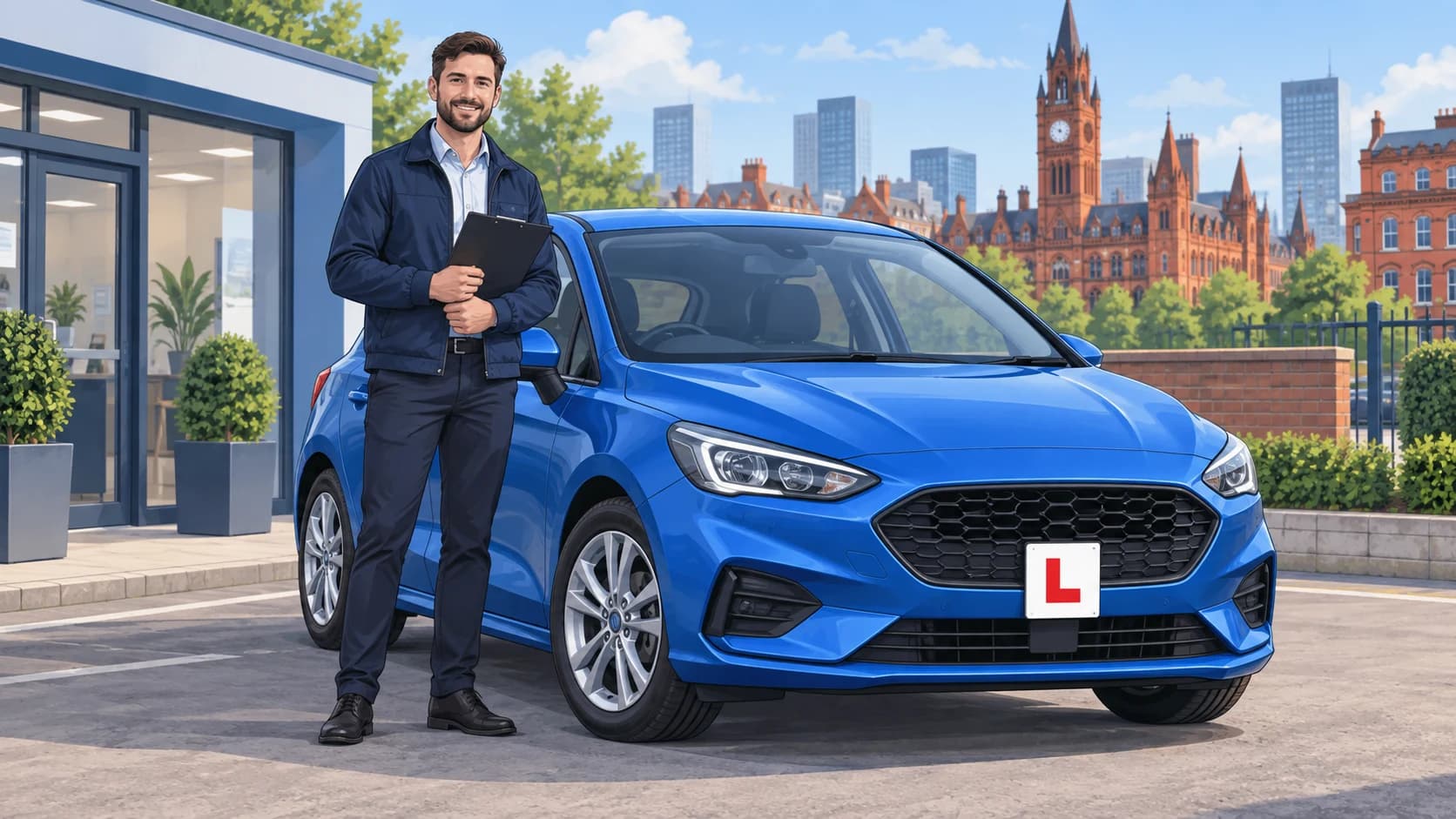
Automatic lessons in Manchester follow the same road to a driving licence as any other lessons, but the stages along the way look a little different. With no clutch pedal and no gear changes to learn, early lessons move faster into real driving, and later lessons spend more time on judgement and independence. This page walks through what automatic lessons cover, stage by stage, so you know what to expect before you sit in the driver's seat for the first time.
Before your first lesson
You need a provisional driving licence before taking lessons on public roads. Your instructor will want to see it, and will check your eyesight as part of getting started. Your first lesson usually begins away from traffic, somewhere quiet, so you can get used to the car without pressure. That first session is about familiarity: where everything is, how the car responds, and what your instructor expects from you.
First steps: controls, moving off, and stopping
The first stage of automatic lessons covers the controls of the car. You will learn the two pedals — accelerator and brake — and how to select drive, reverse, neutral, and park. Your instructor will show you the mirrors, the indicators, and the seating position, and explain the observation routine you will use before every move: mirrors, signal, manoeuvre.
Then comes moving off and stopping. In an automatic, moving off means checking around you, signalling, releasing the brake, and pressing the accelerator gently. Stopping means braking smoothly to a halt and securing the car. Because there is no clutch to coordinate, learners usually get comfortable with moving off and stopping quickly, and the lesson can move on to steering: holding a straight line, steering around gentle bends, and turning at quiet junctions.
Building up: junctions, roundabouts, and traffic
Once you can move off, stop, and steer with confidence, lessons move into busier driving. You will learn to approach and emerge at junctions, judging gaps in traffic and deciding when it is safe to go. Roundabouts come next, starting with smaller ones and building to larger, multi-lane layouts where lane choice and signalling matter.
This stage also introduces meeting traffic, passing parked cars, and driving on busier roads. Your instructor will teach you to read the road ahead rather than just reacting to what is immediately in front of you: spotting a bus pulling out, a pedestrian stepping towards a crossing, or a cyclist filtering past. In an automatic, your attention is free for this kind of observation, because you are not thinking about gears.
Manoeuvres and parking
Manoeuvres are the precise, slow-speed skills of driving, and automatic lessons cover all of them. You will practise parallel parking, bay parking both forwards and reversing in, and pulling up on the right-hand side of the road before reversing back. Each manoeuvre is broken into steps: observation first, then slow, controlled movement with constant checks around the car.
Automatic cars make manoeuvres a little simpler, because you control speed with the brake alone and never worry about stalling midway through. That does not mean manoeuvres take care of themselves — accuracy comes from observation and steering, and your instructor will keep correcting those until they are habits rather than conscious efforts.
Independent driving and test preparation
Later lessons introduce independent driving: following road signs or a sat nav to a destination without turn-by-turn instruction, exactly as the practical test requires. This is where everything comes together. You plan your route, make your own decisions at junctions and roundabouts, and deal with whatever the road presents, while your instructor watches and only steps in if needed.
As you approach test standard, your instructor will run mock tests: full practice tests under test conditions, with the same structure as the real thing. Mock tests show you what test day feels like and highlight anything still to polish. Your theory test runs alongside all of this — the Highway Code, hazard perception, and road rules you study for theory are the same rules you apply on every drive.
After the test
Passing your practical test in an automatic car gives you a licence for automatic cars only. That is the one lasting consequence of the automatic route, and it is worth knowing from the start rather than discovering afterwards. If you later want to drive a manual car, you can take a further practical test in a manual car to remove the restriction. GOV.UK explains the categories: an automatic-only entitlement appears as category B auto, or category B with restriction code 78.
If you are ready to start, you need your provisional licence and a first lesson booked with door-to-door pickup across Manchester. Your instructor will take it from there, one stage at a time.
Sources: book a practical test through GOV.UK (https://www.gov.uk/book-driving-test); licence categories, including the automatic-only entitlement, are explained on GOV.UK (https://www.gov.uk/old-driving-licence-categories).
Learning to drive in Manchester?
Free mock theory tests and hazard perception practice, and lessons with instructors who can see how you're doing.