Automatic Driving Lessons in Manchester
Automatic driving lessons in Manchester with door-to-door pickup. Learn in an automatic car with no clutch or gears to master, and find out who automatic suits.
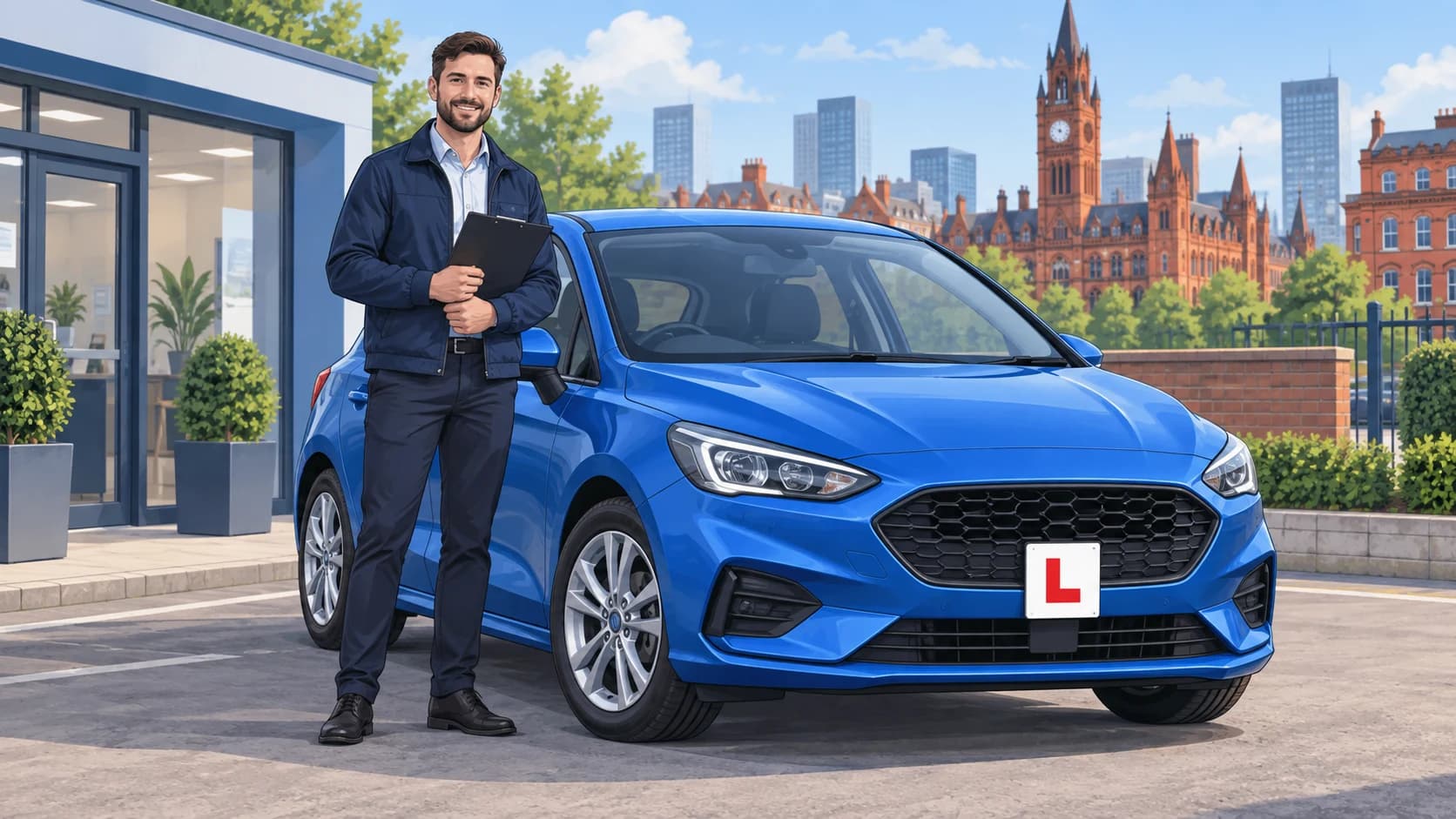
Automatic driving lessons in Manchester take the clutch pedal and the gear lever out of learning to drive. You still learn everything a safe driver needs — observation, judgement, positioning, and control — but the car chooses the gear for you, so your attention stays on the road rather than on your feet. Lessons come with door-to-door pickup across Manchester, so you start and finish at home, work, or college. This page explains what automatic driving means, who it suits, what you will learn, and the one licence point to settle before you start.
What driving an automatic actually means
An automatic car has two pedals instead of three: accelerator and brake. There is no clutch pedal, and you do not change gear by hand. You select drive, reverse, neutral, or park, and the car handles gear changes itself as your speed changes. That removes the two jobs that trip up many new drivers: coordinating the clutch with the accelerator, and choosing the right gear at the right moment.
It does not remove the driving itself. You still steer, judge gaps, read the road, anticipate other road users, and control your speed. Stalling because of clutch control stops being something to worry about, which is why many learners find their early lessons feel calmer in an automatic. In stop-start city traffic, an automatic simply creeps and stops with the brake, leaving you free to watch the traffic around you.
Who automatic lessons suit
Automatic suits any learner who wants one fewer thing to coordinate while learning. If you have tried manual lessons and found yourself overwhelmed by clutch, gears, steering, and observation all at once, automatic strips the workload back to steering, observation, and speed. Nervous learners often find that helpful: with fewer controls competing for attention, there is more mental room for reading junctions and making decisions.
Automatic also suits learners who know they will drive an automatic car afterwards. If the car you will use at home is an automatic, learning in one means every lesson is spent in the kind of car you will actually drive. Drivers returning to driving after time away sometimes choose automatic for the same reason: it gets them back to confident, everyday driving without relearning clutch control. And if your driving will mostly be city driving, with queues, traffic lights, and roundabouts, automatic takes the repetitive gear-changing out of every journey.
What you will learn
Automatic lessons cover the same road skills as manual lessons. You will learn to move off and stop smoothly, handle junctions and roundabouts, use dual carriageways, and drive in residential streets and busier traffic. You will practise manoeuvres including parallel parking, bay parking, and pulling up on the right, and you will learn to drive independently by following road signs or a sat nav, as the practical test requires.
Your instructor will also prepare you for the theory test, which covers the Highway Code, hazard perception, and the rules of the road. Theory preparation runs alongside practical lessons, so the two build on each other: what you study in theory shows up in real decisions on the road, and what you meet on the road makes the theory easier to remember.
The licence point to settle first
There is one decision to make before you choose automatic, and it concerns your licence. If you pass your practical test in an automatic car, your licence covers automatic cars only. If you pass in a manual car, your licence covers both manual and automatic cars. GOV.UK explains this through the licence categories: an automatic-only entitlement appears as category B auto, or category B with restriction code 78, and it means you cannot drive a manual car with that entitlement.
That matters only if you expect to drive a manual car later. If you will drive automatics, an automatic licence covers everything you need. If you might need a manual later, you can take a further practical test in a manual car to remove the restriction. The sensible question to ask yourself is simple: what kind of car will you actually drive once you pass? Answer that, and the automatic-or-manual choice mostly answers itself.
Learning in Manchester
Manchester gives automatic learners a useful mix of roads. Quiet residential streets are good for first steps and manoeuvres, busier routes build judgement in real traffic, and dual carriageways add higher-speed experience. Because lessons start with door-to-door pickup, you learn on the roads around your own area rather than travelling to a fixed meeting point, and your instructor can vary the routes as you progress, moving from familiar streets to unfamiliar ones so you learn to read new roads rather than memorise old ones.
How to get started
You need a provisional driving licence before taking lessons on public roads. You can start lessons while preparing for your theory test, and your practical test can only be booked once you have passed the theory test — practical test bookings are made through GOV.UK. If you are unsure whether automatic is right for you, talk it through with your instructor at the start: the licence point above is the main trade-off, and everything else about automatic learning is about making the early stages simpler.
- GOV.UK, "Book a driving test", https://www.gov.uk/book-driving-test
- GOV.UK, "Compare old and new driving licence categories", https://www.gov.uk/old-driving-licence-categories
Learning to drive in Manchester?
Free mock theory tests and hazard perception practice, and lessons with instructors who can see how you're doing.