
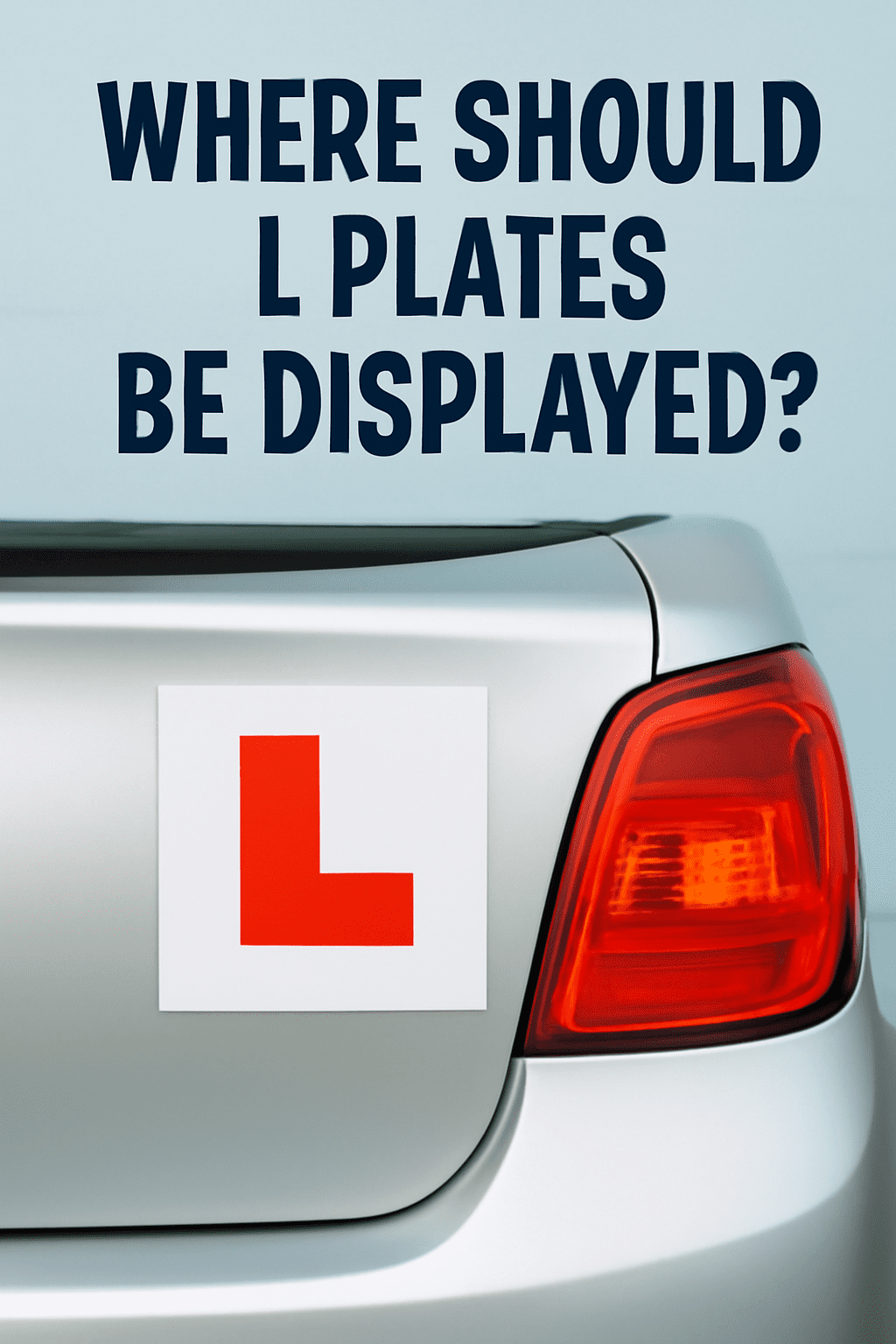
If you’re a UK learner driver, one of the most important things you need to learn right now is when and where to display your L plates. L plates. If you’re learning to drive, displaying L plates is not only common sense, it’s a legal requirement, and the last thing you want is to be hit with a fine before you’ve even earned your licence! But where are you supposed to actually put L plates? Read on for the specifics on where and how to display your L plates so that you’re following the law and driving safely.
What Are L Plates?
“L plates” are a must for any learner driver in the UK. The L is for “Learner,” and these plates tell other drivers on the road that you’re a new driver. L plates serve a dual purpose in helping to inform others of your level of driving experience – ensuring greater care is taken when dealing with you on the road.
Official L plates are square and have a white background with a large, bold red letter L in the middle. You need to be put on both the front and rear of the car, and sit in a place where they are easily visible, while you are learning to drive.
Where on the Car Should I Display L Plates?
To adhere to UK road law and make sure your L-plates can be seen by other road users, here are the precise places you need to display your L-plate on the most popular vehicles:
1. Front of the Vehicle
The ‘L’ plates on the front of the vehicle should be visible to other road users. It is best to mount it at the front of the vehicle, on the windscreen.
Position: The L plate must be fixed to the front screen or the front bumper.
- Visibility: Be sure that the plate is easily visible and does not have anything blocking it or the car blocking part of it.
- Legal Rule: The plate must be fixed on the front of the car whenever you’re driving as a learner.
2. Rear of the Vehicle
The L plate at the back should also be clearly visible to drivers behind you. That is so drivers behind will know you are a learner and may drive slower or hesitantly.
3. Location: L Plate must be exhibited on the back windshield or back bumper.
visibility= the plate has to be clearly visible to other drivers (couldn’t be obstructed- which would have to include not having someone’s butt in the mist too, though…)
- Legally Required: Just like the front, you’ll need to show the L plate when you’re practising driving at the rear.
4. Legalities of L Plates on Your Car
In the UK, there are specific laws regarding the use of L plates:
- Front and Back: You need to fit L plates at the front and rear of the vehicle when carrying out your learner driver duties.
- Clear and Visible: It’s important that other drivers can see where the L plates are. They cannot be obscured by any part of the car or anything in it (tinted windows, stickers, etc.).
- Size and Style: The L plates should come in a standard size (usually 178mm by 178mm), and they should have the boldly printed red “L “in the middle with a white background. The construction must be made in accordance with the usual plan to satisfy legal necessities.
When you’re learning to drive (in the UK) during lessons: For any part of a journey that you’re driving as a learner, in addition to plates that say ‘L’, your car must have: As a driver, it’s your responsibility you ensure the plates are kept clean and fixed correctly.
Can L plates Be Displayed Elsewhere?
Despite the law stating L plates must be placed on the front and back of the car, there are some “loopholes” when it comes to where on the windows you place them. Still, there are several caveats to this:
It is Important to have the plates visible, and also make sure that they are not preventing you from seeing out the window or into the mirror.
- Do Not Use Decorative L Plates: The L plates must be of the correct size and clear. L plates, or decorative/non-legal L plates, may not meet legal requirements, so stick to legal plates at all times.
- Vehicle Type Vetting: For vans or trucks, the L plates need to be placed in a visible area for other drivers, and the same legal standards apply.
What if They Don’t Display L Plates Properly?
Not showing L plates correctly is illegal according to driving law in the UK. But if you are caught driving without L plates, or they are displayed in an incorrect way where other road users cannot see clearly, you could be penalised with:
Fines: If you don’t follow this law, you can be fined.
Points on Your License. It is unlikely you would receive points on your provisional motoring license, but repeated failure to show ‘L’ plates could mean issues with your progression.
- Test Disqualification: If you’re caught without L plates while driving during your driving test, you may be disqualified from taking the test.
L Plates and What you need to take your driving test
You don’t need to display L-plates once you’ve passed your driving test. But until you pass, you have to have them out at all times, whether you’re in a driving lesson or practising with a professional supervisor.
Conclusion: Always Make Sure Your L Plates Are Displayed Properly
Correctly displaying your L plates is also crucial for your safety and ensuring that you’re driving legally on UK roads. Make sure the L plates are visible on the front and back of your car at all times; otherwise, you risk fines and need others on the road to know you are still learning.
For professional driving instructions and additional guidance on how you can pass your UK driving test, see WWW.LearnandDrive.UK. Read more Oops – nothing in this comment! Teachers to give you the support you need.
Stay safe, and happy driving!